



















Children's Art Worksheets “You Are My Sunshine”
Datum


The Hunt for Energy
On this page, I’d like to introduce you to a type of creative project work with traumatized children. You can find an introduction to the topic “here (on the home page for the children’s worksheets)”: https://arteurope.de/shop/KinderblaetterBootsonGround#info
In the last chapter, I told you about a girl with a severe communication disorder. Using a specific technique, I described how her creativity—which had been trapped within rigid boundaries—could be unlocked again. The beginning of a success story…
…but that’s not always how it goes.
Nevertheless, you can initiate lasting change with a creative-pedagogical approach. It doesn’t always result in a game-changing effect. Sometimes the severity or depth of trauma prevents that. But that doesn’t mean the work is ineffective.
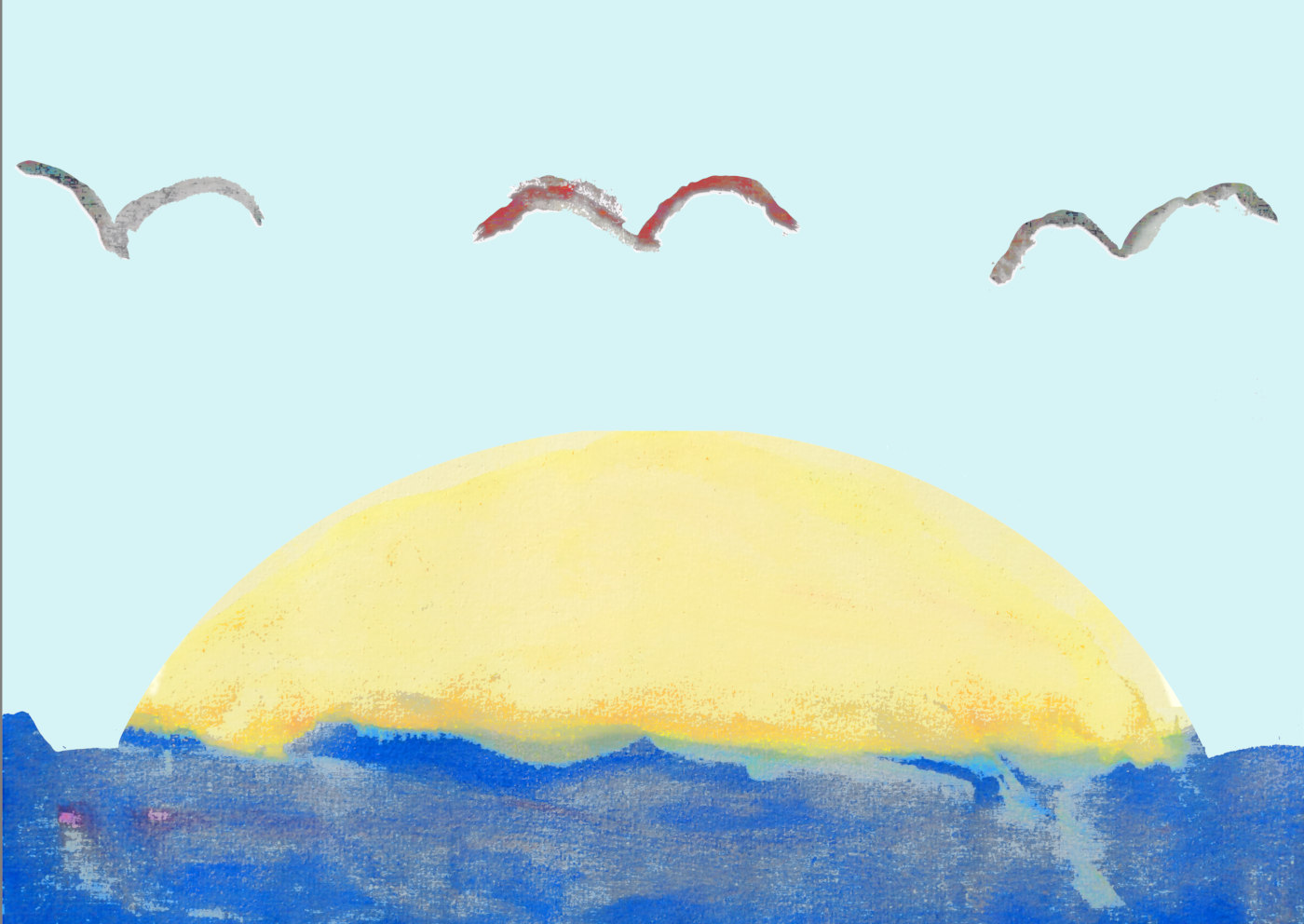
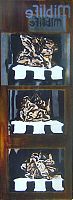
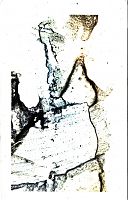
Die Drei, Giclée-Print alle Größen bis 60 cm x 84 cm DIN A1, RLP 2023
In this chapter, I’ll introduce you to a boy who possessed an incredible ability: he could drain your energy. I can’t put it any other way. Well-rested, I arrived at the facility with well-prepared activities and full of joyful anticipation about everything that had happened in the meantime and what new developments might emerge in the course of my playful interventions.
I’m an artist—I have been for a long time, actually, for as long as I can remember. On top of that, I have experience and training from the Hamburg Academy of Fine Arts, followed by solid training as a certified social worker and media educator in Cologne. This combination opens up opportunities for me that remain closed to other artists. That’s wonderful, but it also comes with responsibilities.
The welcome that day was a bit lackluster. Only the boy, nine years old, stopped me right at the door. He asked the usual questions about the children’s program: whether we’d go get ice cream and when. I noticed that he didn’t even wait for me to answer his questions. It continued right away: Where? How many scoops? Would I be okay with him ordering a Malaga scoop along with his strawberry scoop? Oh, is that allowed? But there’s alcohol in it!
My question about where the other kids were fell on deaf ears.
Now the conversation turned to TV and the fact that he was already allowed to watch a movie rated FSK 12. His grandma had given him permission. He seems to have a desperate need for adult attention, I thought in that moment, and tried to steer the conversation from the future back to the present. Since all the children knew that I was interested in art, I asked my now-obligatory question: whether he had painted anything new since my last visit. He hesitated and led me to the drawing and board game corner of the living room, to the low square table that had another shelf beneath its top, from which he pulled out a stack of mostly A4-sized painted sheets—some torn, many crumpled. He fanned them out across the table and found a thick orange marker on the floor; he snapped off the cap and tossed it toward me. It rolled under the couch. Using the marker, he now tapped on the sheets—mostly printed coloring book outlines of various comic book heroes, unicorns, and mermaids—so that thick orange dots appeared all over them, and he explained to me what each sheet depicted. When I asked if he had drawn all of that, he ignored me again, but this time he stopped making dots and instead circled certain areas in bold or traced the outlines while telling me that unicorns don’t really exist—mermaids might, but he wasn’t sure about that. “Have you ever seen one…?” A girl walked into the room, stood in front of the table with her mouth agape, and then ran up the stairs crying, her voice loud and accusatory: “…and he’s just standing there watching.”
I took the marker out of his hand. Yes, I probably should have seen that coming and taken the marker away from him right away, but one way or another, you’re always going to miss the best moment to intervene—and when that happens, it’s very, very important not to scold or accuse the child if you plan to continue working creatively with them. Of course, a corrective remark would have been necessary—but that wasn’t my job.
I increasingly got the impression that he was predicting my reactions to his actions quite accurately. It actually seemed to me as if he had wanted us both to laugh together at the crying girl.
If I was right, he had offered me a “backdoor” deal to be his accomplice—and in a very creative way.
“Can you see into the future?” I asked him, and he seemed genuinely surprised that I didn’t even begin to scold him. I explained to him that all the girls were about to come down, and I wasn’t going to protect him from their wrath.
I suggested that, thinking ahead, he could paint a few unicorns himself and offer them up as a lightning rod to the approaching mob seeking revenge. He immediately agreed to the idea of going to the art room to paint something, but as for letting the finished piece be defaced by everyone—well, he wasn’t sure yet if that was what he wanted.
We cautiously made our way to the art room, and as a precaution, I locked us in. One might think that a room like this should be left open, perhaps with a note asking that no unwelcome visitors come in. But in this specific case, I didn’t want to give any further encouragement to this boy’s destructive creativity, so I locked the door without him noticing. If the girls came in and teased him, I wanted to avoid spontaneous reactions that might pull us away from the work we’d just begun.
I set everything up—real watercolors, the studio kind, three brushes, and a 220 g/m² sheet of studio watercolor paper—and, just to be safe, draped a kitchen towel over my shoulder. Then he sat there, fidgeting with his legs, staring at the white paper.
In a case like this, it’s important to start working on the entire sheet relatively quickly. He agreed to a sky—which can make up a third, half, or two-thirds of the page, depending on the situation. The sheet, secured with masking tape to a freely movable surface, is tilted slightly so that when paint is applied to the lower edge of the painted area, a droplet forms. It shouldn’t run off. Using this drop, you can continue to fill in the intended area evenly “line by line,” resulting in a homogeneous field of color. Toward the center of the sheet, you load the brush with a little more water, creating an airy sky that curves toward the horizon. This atmosphere, created by the child alone, breaks through the “white noise” in almost every case, and suddenly things get going.
But here, nothing happened at all.
Maybe it was because of my aura. I hadn’t been here even an hour yet, still had five hours to go, a major blowout with all the unicorn artists still ahead of me, and I was just completely drained. The boy, however, seemed to be focusing all his attention on the room outside and was probably expecting the girls to storm in. He kept glancing toward the door. I would have liked to ask him what he was waiting for, but I held back. Perhaps even asking the question would have triggered the impulse to get up and leave the room. So it took him a long time to paint the sky, and it wasn’t even, because the paint dried faster than he could apply it. He didn’t seem to have understood the dripping technique.
When there were no sounds at all coming from outside, he suddenly yelled at me after I suggested that he might paint gray-blue mountains on the horizon at the edge of the sky. It felt like trying to start a vintage car that just wouldn’t catch. He added some water—and yelled again—then listened to see if anything was finally stirring outside the door.
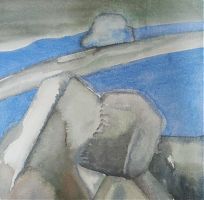
A paintbrush fell to the floor; when he tried to catch it, he missed the brush but hit the cup of water—spilling everything all over the table. That’s when the kitchen towel I’d set aside just in case came in handy. He watched me silently as I mopped up the water and set a new cup in front of him. His painting had gotten a little wet, too. I handed him a paper towel; he didn’t know what to do with it. “Dab the puddle of water off your painting—that’s how you get clouds.” And finally, he found something fun to do. Now the lower part was smeared with blue too, and the paper towel was in constant use. “Do it more in just one direction and you’ll get waves”—he went along with that, too, and then he came up with a daring idea: dampen the sky again, wipe out a spot for the sun, and fill it with yellow.
It was a simple composition. The sun melted into the sky and the water on the right side of the picture, both of which took up exactly half the space. He was thrilled with his artwork. He’d never painted anything so beautiful before. And what should he call it? He thought about it. “The Two Friends,” it occurred to him. “Which friends?” He scanned his painting. “Maybe you want to paint a few birds in there.” Yes, he wanted to, but how and where—and hopefully he wouldn’t mess it up—“Please, you do it.”
So I took a sheet of paper, and I’m sure you already know what’s coming next: analyzing the composition of the image while simultaneously sketching my own. It’s a good, straightforward picture without any unnecessary details—the sea, the sky, sunshine. I allocated nearly three-quarters of the space to the sky, stuck crepe paper across it, then applied a base coat to the water in the lower section and wiped away the paint exactly in the center to make room for a large sun. Using a small brush attached to a string secured with tape, I drew the semicircle for the sun and added a black bird just past the right edge.
That gave him courage, and he added a bird symmetrically on both the left and right sides of his leaf. We smiled at each other. Those are the two friends. I increased the number of birds in my picture to three “friends” and was curious to see what would happen,
Nothing.
He raised his sheet above his head and said several times, “My sunshine. Would you like to write that on it?” He wrote—on the back—“My sunshine with two friends.” Meanwhile, I quietly unlocked the door again. He stormed into the living room with the sheet. My colleague had gathered the girls together and creatively redirected their frustration into a cake-baking session. With relish and loud smacking sounds—perhaps to make sure the “picture-phobe” definitely noticed how good it tasted—they scraped and licked the bowls clean. But his only problem now was where and how he could hang his picture so it wouldn’t get crumpled.