From the Voynich Manuscript to the Indus Script: Writing, Religion and Political Order between Enigma and Scholarship
Datum


Introduction
The Voynich Manuscript, the script of the Indus civilisation, and the Sumerian and Akkadian texts rank among the most fascinating surviving records from the early history of writing. Yet they present profoundly different scholarly problems:
- The Voynich Manuscript can be situated with reasonable confidence in material and chronological terms, but its text has still not been convincingly read.
- The Indus script emerged from a highly developed urban civilisation, yet remains undeciphered because of the brevity of its inscriptions and the absence of a bilingual inscription.
- Sumerian and Akkadian texts, by contrast, are readable. They speak of gods, temples, kings, labour, warfare and administration, thereby offering direct insight into a society documented in writing.
A comparison of these cultures shows that technological and administrative complexity did not everywhere assume the same political or religious form. Mesopotamia represented gods, kings and temples on a monumental scale. The Indus civilisation, by contrast, left behind above all standardised cities, waterworks, weights, bricks and objects of trade – but, so far, no unambiguously identified royal palaces or inscriptions of rulers.
1. The Voynich Manuscript: A Wealth of Material Knowledge, but No Secure Reading
The Voynich Manuscript is an illustrated codex dating from the early fifteenth century. Radiocarbon dating places the parchment approximately between 1404 and 1438. It contains botanical, astronomical, biological and possibly pharmaceutical illustrations, together with an extensive text written in a script that has not been convincingly deciphered to this day.1
Research can now say a considerable amount about the object itself:
- The parchment is medieval.
- The manuscript was probably produced in Central Europe.
- The script follows statistical patterns that in some respects resemble those of language.
- The illustrations belong to several different thematic fields.
- Several scribes, or at least several phases of writing, have been proposed.
- Earlier traces of ownership have been rendered more visible through imaging techniques.
The central question, however, remains open: is this an unknown natural language, an artificial language, a complex cipher, or perhaps a text without genuine linguistic meaning?
An important recent development was the study of the so-called Naibbe cipher, published in 2025. Michael A. Greshko developed a historically plausible method capable of transforming Latin or Italian texts, using cards, random selection and multi-stage substitution, into a script whose statistical properties partly resemble those of the Voynich Manuscript.
The method does not decipher the manuscript. It merely demonstrates that the cipher hypothesis remains technically plausible.2
The state of scholarship may therefore be summarised as follows:
The Voynich Manuscript has not been deciphered. Recent work has narrowed the range of possible explanations, but has not yet produced a translation.
Claims that the manuscript has been completely read as Latin, Hebrew, Sanskrit or another language cannot be regarded as established so long as they do not work reproducibly across the entire corpus and have not been independently confirmed by other researchers.
2. The Indus Script: A Highly Developed Civilisation without a Readable Self-Description
The Indus or Harappan civilisation flourished during its mature urban phase approximately between 2600 and 1900 BC in what is now Pakistan and north-western India. Among its centres were Harappa, Mohenjo-daro, Dholavira and Ganweriwala.
Archaeologically, this civilisation is exceptionally well attested. It possessed:
- large, carefully planned settlements,
- standardised brick dimensions,
- standardised weights,
- wells and water-management installations,
- extensive drainage systems,
- specialised crafts,
- long-distance trade extending to the Persian Gulf and Mesopotamia,
- seals and inscribed objects.
The Indus inscriptions, however, are usually very short. Many consist of only a few signs; longer inscriptions are rare. This makes it difficult to identify grammar, word boundaries and recurring syntactic patterns. In addition, no bilingual inscription has yet been found that might – like the Rosetta Stone in the decipherment of the Egyptian hieroglyphs – connect a known script with an unknown one.3
The number of signs is itself disputed. Depending on how variants and ligatures are counted, estimates range from several hundred to considerably more. This raises a fundamental question: are we dealing with a fully developed writing system, a logosyllabic script, an administrative script with a limited vocabulary, or, at least in part, a system of symbolic markings?
The Indus script therefore remains unresolved. Computer analyses can examine sequences of signs, frequencies and positional patterns, but they cannot substitute for decipherment. Nor are recent AI-based proposals or preprints automatically evidence. What matters is whether a proposed reading:
- can account for a large number of different inscriptions,
- reveals recognisable grammatical rules,
- can be used predictively to read previously unknown texts,
- accords with archaeology and the history of languages,
- and can be independently reproduced.
3. Schildmann’s Decipherment
Kurt Schildmann proposed a Sanskrit, or “Paleo-Sanskrit”, interpretation of the Indus script. He claimed that the signs could be read through a combination of phonetic signs, syllabic signs and pictorial signs. Among his keys were pictorial motifs on seals, which he interpreted as a form of “pictorial bilingualism”.4
Schildmann’s approach is of interest to the history of research, but it is not treated as an accepted decipherment. The principal reason is not simply his status as an outsider, but the absence of external validation:
- There is no generally accepted sign chart.
- The proposed phonetic values are not independently derived from a secure bilingual foundation.
- The method has not been reproduced by specialists in the field.
- The proposed readings have not been demonstrated to work across the corpus as a whole.
- The claimed results are in some cases linked to far-reaching cultural and historical assertions that extend beyond the epigraphic evidence.
This does not mean that every individual observation made by Schildmann must be worthless. Particular comparisons of signs or individual hypotheses may be of interest. A complete decipherment, however, must achieve more than plausible individual translations. It must provide a coherent and testable system.
The fair scholarly formulation is therefore:
Schildmann’s work is not disregarded because it is unconventional. It has not been incorporated into the scholarly consensus because its readings have not yet been independently, systematically and reproducibly confirmed.
4. Religion in the Indus Civilisation: Absence or Invisible Religion?
The Indus civilisation is often described as strikingly “religionless”. That formulation, however, is too strong. What can properly be said is this:
- There are no securely identified large temples comparable to those of Mesopotamia.
- There are no securely readable religious texts.
- There are no unequivocally identified royal figures or “priest-kings”.
- Many figurines and seal motifs are ambiguous.
- The Great Bath at Mohenjo-daro may have served a ritual purpose, but it has not been securely demonstrated to have been a temple complex.
The absence of clearly identifiable temples does not entail that the people of the Indus civilisation worshipped no gods. Religious practices may have taken place within households, in small shrines, around water installations, in open spaces, or in forms that are difficult to detect archaeologically.
It is equally possible that political organisation was less heavily centred upon publicly displayed rulers and temples.
Standardised bricks, weights, cities and water installations certainly demonstrate a high capacity for coordination. They do not, however, prove the existence either of a central king or of an authoritarian state.
Several models are conceivable:
- a centrally administered kingdom,
- several cities sharing common cultural norms,
- a network of local elites,
- a more collective or institutional form of urban administration,
- different political forms emerging in different regions and periods.
The archaeological evidence does not currently permit a definitive choice among these possibilities.
5. Sumer and Akkad: Gods, Temples and Political Order
In southern Mesopotamia, a different form of urban society developed. Sumer consisted of competing city-states such as Uruk, Ur, Lagash, Umma and Nippur. Each city possessed its own patron deities, temples and political institutions.
The temple was not merely a religious institution. It was at the same time:
- a landowner,
- a centre for storage and distribution,
- an employer,
- a creditor,
- an administrative apparatus,
- an organiser of irrigation and labour,
- a symbol of the political identity of the city.
Later, palaces and military kings came to stand more prominently alongside the temple economy. During the Akkadian period, religious institutions were also incorporated into imperial rule. The king presented himself as legitimised by the gods; political authority and religion were consequently closely intertwined.5
The Mesopotamian ziggurats were elevated temple structures, or monumental platforms, associated with the city’s gods. Their precise original function is not always certain in every detail, but they embodied the connection between city, temple, deity and political order.
6. Against Whom Were the City Walls Built?
The existence of gods and temples did not make human conflict obsolete. Mesopotamia was politically highly fragmented. City-states competed for:
- irrigated land,
- arable land,
- trade routes,
- labour,
- grazing land,
- raw materials,
- religious prestige.
City walls could provide protection against neighbouring cities, local rulers, nomadic groups, uprisings or raiding bands. They also served other purposes:
- protection against flooding,
- control of entrances and exits,
- demarcation of the political community,
- the display of power and prosperity.
The idea that the gods created human beings as a labour force is particularly explicit in the Akkadian Atrahasis epic. There, lesser gods rebel against the arduous work of digging canals. Human beings are subsequently created to undertake that labour.6
This is not, however, a sober account of an early constitution. The myth explains and legitimises a social order:
- Human beings labour.
- They provide for temples and gods.
- Priests and kings organise labour and tribute.
- The cosmic order appears as the foundation of the social order.
The portrayal of human beings as servants of the gods therefore probably also reflects the lived experience of Mesopotamian labourers and farmers. The myth transforms social obligations into a cosmic necessity.
7. Sumerian and Akkadian
“Sumer” and “Akkad” are not simply two entirely separate civilisations.
Sumerian is a language whose relationship to other known language families has not been securely established. It was used primarily in southern Mesopotamia and remained an important written and learned language for a long period.
Akkadian, by contrast, belongs to the Semitic language family. It was spoken and written in several dialects, including Babylonian and Assyrian. During the period of the Akkadian Empire and thereafter, Sumerian and Akkadian coexisted for centuries. Sumerian continued to serve as a learned and liturgical language even as Akkadian increasingly became the language of everyday life.
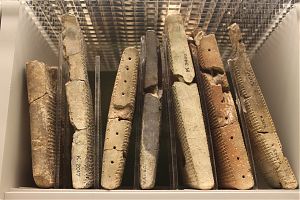
Cuneiform was capable of recording both languages. This is a crucial difference from the Indus script: for Sumerian and Akkadian there exists a vast body of administrative documents, contracts, letters, legal texts, school texts, hymns and myths. This makes it possible to study linguistic development and social institutions comparatively well.
8. Why Does the Indus Civilisation Appear So Different?
The contrast between the Indus civilisation and Mesopotamia may be attributable to several factors:
Different Political Systems
Mesopotamia was characterised by numerous competing city-states. These had to make their authority visibly legitimate. Temples, kings, walls and accounts of warfare were particularly well suited to this purpose.
The Indus civilisation may have been more integrated, more decentralised, or organised along altogether different political lines. Without readable texts, the matter remains open.
Different Forms of Religious Representation
Mesopotamian religion was extensively represented through temple architecture, statues, hymns and myths. In the Indus civilisation, religious ideas may instead have been expressed more strongly through small seals, animal motifs, water practices or domestic rituals.
Different Archaeological Records
Not every form of political power leaves behind palaces. Power may also reside in administration, standardisation, infrastructure, provisioning and the control of trade routes. Modern states demonstrate that strong political coordination need not necessarily take the form of royal monuments.
That general observation, however, must not be used directly as evidence for the Indus civilisation. The fact that the Indus cities were standardised does not in itself prove that the society was either strongly centralised or particularly egalitarian.
9. A Cautious Overall Synthesis
The comparison may be summarised in three sentences:
- Mesopotamia is a society that comments upon itself in writing: it tells us about its gods, kings, temples and conflicts.
- The Indus civilisation is an archaeologically highly developed but linguistically silent society: we can see its cities and standards, but we cannot understand its political and religious language.
- The Voynich Manuscript is a materially well-preserved but semantically closed individual object: here we know neither the content nor, with certainty, the purpose of the text.
The real enigma, therefore, is not that one culture must necessarily have lacked religion or rulers. It is that different societies made their social order visible in profoundly different ways.
Mesopotamia monumentalised gods, temples and kings. The Indus civilisation may instead have monumentalised urban planning, water, standardisation and trade. Whether this reflected a centralised government, a network of elites, or another form of social organisation can only be established through further archaeological discoveries or a reliable decipherment of the Indus script.
Conclusion
Scholarship should therefore distinguish three levels:
- What is securely established?
- What constitutes a plausible interpretation?
- What is a far-reaching claim that remains unconfirmed?
In the case of the Voynich Manuscript, it is securely established that we have a medieval codex written in an unusual script. In the case of the Indus corpus, it is securely established that a highly developed urban civilisation existed with a system of signs that remains unread. In the case of Sumer and Akkad, numerous religious and political texts are readable.
What is not securely established is:
- whether the Voynich script is a cipher or a language,
- which language lies behind the Indus script,
- whether Indus society was centrally or decentrally organised,
- whether the Indus signs primarily recorded language, administration or symbolism,
- and whether individual modern “decipherments” genuinely explain the system as a whole.
It is precisely this distinction between evidence and interpretation that makes comparative scholarship productive. It prevents both premature claims of decipherment and the equally premature assumption that a culture without readable royal or temple texts must have been either without religion or politically simple.
Footnotes
Selected Literature
- Crawford, Harriet, ed. The Sumerian World. Routledge, 2013.
- Foster, Benjamin R. The Age of Agade: Inventing Empire in Ancient Mesopotamia. Routledge, 2016.
- Greshko, Michael A. “The Naibbe Cipher: A Substitution Cipher that Encrypts Latin and Italian as Voynich Manuscript-like Ciphertext.” Cryptologia, 2025.
- Kenoyer, Jonathan Mark. Works on the Harappan civilisation, Indus cities, trade, technology and social organisation.
- Liverani, Mario. The Ancient Near East: History, Society and Economy. Routledge, 2014.
- Mahadevan, Iravatham. The Indus Script: Text, Concordance and Tables. Archaeological Survey of India, 1977.
- Parpola, Asko. Deciphering the Indus Script. Cambridge University Press, 1994.
- Schildmann, Kurt. The Scripts of the Indus Civilization.
For the dating of the parchment and the material classification of the Voynich Manuscript, see the holdings and research information of the Beinecke Rare Book and Manuscript Library at Yale University, together with the radiocarbon dating studies carried out on the parchment.↩︎
Michael A. Greshko, “The Naibbe cipher: a substitution cipher that encrypts Latin and Italian as Voynich Manuscript-like ciphertext”, Cryptologia, published online in 2025. The study explicitly makes no claim to have deciphered the Voynich Manuscript; rather, it demonstrates a historically plausible means of generating Voynich-like statistical properties.↩︎
For the Indus script, see Asko Parpola, Deciphering the Indus Script, Cambridge University Press, 1994; Iravatham Mahadevan, The Indus Script: Texts, Concordance and Tables, Archaeological Survey of India, 1977; and Jonathan Mark Kenoyer's work on the Harappan civilisation and the organisation of the Indus cities.↩︎
Kurt Schildmann, The Scripts of the Indus Civilization. Schildmann's Sanskrit-based decipherment is presented at length in accounts by his supporters. Independent scholarly confirmation of his sign chart and translations, however, has not been established.↩︎
For the political and religious role of temples in Sumerian and Akkadian Mesopotamia, see Harriet Crawford, ed., The Sumerian World, Routledge, 2013; Benjamin R. Foster, The Age of Agade: Inventing Empire in Ancient Mesopotamia, Routledge, 2016; and Mario Liverani, The Ancient Near East: History, Society and Economy, Routledge, 2014.↩︎
Atrahasis, an Akkadian epic of the early second millennium BC. Its narrative connects the gods' dispute over labour and irrigation with the creation of humankind and the later Flood. The translation and interpretation of individual passages is more nuanced in Assyriological scholarship than a brief retelling might suggest.↩︎