Stupidity
Datum


Why Stupid People Exist
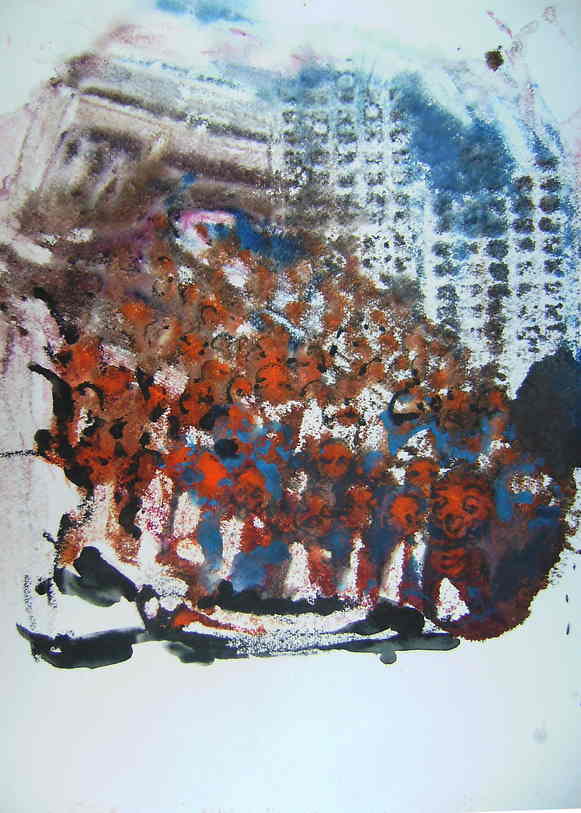
Trabantenstadt Abdruck einer Foliem ca 43cm x 29 cm, Großkönigsdorf 1995
Stupidity is the brain’s energy-saving mode. In a sense, it is its default setting.
Genuine thinking is the more demanding exception, not the rule. Thinking takes energy, requires attention and forces us to question what we take for granted. Nature often favours what conserves resources. The path of least resistance therefore has an inherent appeal.
Seven Reasons Why Stupidity Is Necessary
1. Power requires obedience.
Every system of power depends on a certain degree of obedience. And stupidity provides particularly fertile ground for it: those who do not question things are less likely to resist.
2. Hierarchies reward conformity.
Systems of power often favour people who fit into existing structures. Critical thinking can become inconvenient, while obedience and conformity make advancement easier. Independent thought is not a prerequisite.
3. Collective stupidity arises from conformity.
People adopt opinions, behaviours and convictions from those around them. What everyone considers right is rarely examined again. In this way, collective error can become established as social normality.
4. Certainty takes the place of doubt.
Those who do not doubt themselves project confidence. And those who project confidence can easily gain trust. Society all too often mistakes decisiveness for competence and therefore elevates to positions of power precisely those who see the least reason to question their own convictions.
5. Education can promote conformity rather than thought.
An education system that rewards memorisation more than analysis reproduces knowledge, but not necessarily understanding. Where emotion takes precedence over information, conformity over dissent, and adaptation over independent thought, people emerge who are easier to steer.
6. Being exceptional provokes resistance.
People who think differently sometimes challenge not only established beliefs, but also the social status of those around them. Their abilities may be perceived as a threat. Intelligence is then not recognised but marginalised, while conformity is socially rewarded.
7. Stupidity reproduces itself culturally.
Beliefs, prejudices and habits of thought are passed down from one generation to the next. Those who have never learned to ask questions often pass on no questions either. In this way, stupidity can persist and intensify across generations, independently of individual abilities.
What Does All This Mean?
Stupidity is more than a temporary lack of knowledge. It is not simply an accident, a divine punishment, or a condition that can be remedied solely through better education or more information.
Stupidity serves a purpose in human society. It saves mental effort, facilitates obedience, stabilises social belonging, conveys an illusion of certainty and makes people more susceptible to manipulation. It can be socially rewarded and passed on culturally.
Perhaps the most disturbing thing about it is this: stupidity does not even have to be intentional. It is enough for a society to create structures in which independent thought costs more than mindless conformity.
Stupidity is not merely tolerated. It is needed. Though not necessarily by the people who produce it, but by the structures that benefit from it.